
THE MYTHOLOGY OF 1066
By Lisa Knoll
28/09/2026
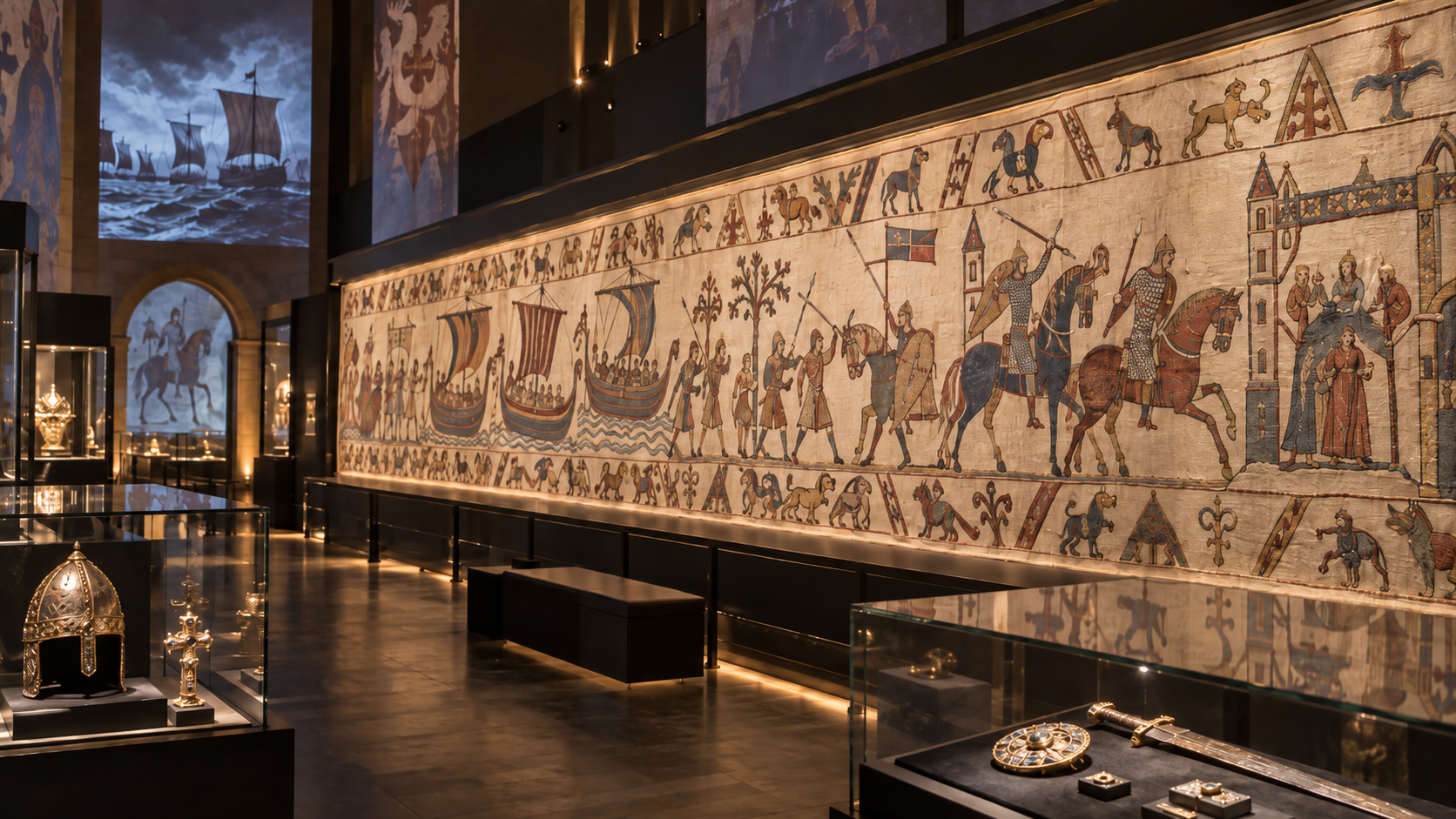
The Bayeux Tapestry returns to England after nearly a thousand years — and asks, in Roland Barthes' terms, what it means for history to be stitched to look like myth.
In Mythologies (1957), Roland Barthes described myth as a "second-order" system of meaning: a way of taking something historical, contingent and man-made, and dressing it up to look like simple, natural fact. Myth's real trick, for Barthes, is not that it lies outright, but that it empties an event of its history and politics and presents what remains as timeless common sense — as something that could not have been otherwise [1]. He was writing about adverts and wrestling matches, but the mechanism he described applies unusually well to an object currently on display at the British Museum: the Bayeux Tapestry, back on English soil for the first time in nearly a thousand years.
The Tapestry's return is being marketed, understandably, as a historical event in its own right — the British Museum's director, Nicholas Cullinan, has called it "one of the most important and unique cultural artefacts in the world". But the Tapestry was never a neutral record to begin with. Most scholarship places its commission with Bishop Odo of Bayeux, William the Conqueror's half-brother, likely within a decade of the Battle of Hastings itself, and reads its 70 metres of embroidered narrative as a carefully constructed justification for the Norman invasion rather than a disinterested chronicle of it [2]. The Tapestry does not simply show what happened in 1066; it shows what the victors needed 1066 to have looked like.
This is precisely Barthes' second-order operation at work. The Tapestry takes a violent, contested seizure of a foreign throne and re-narrates it as an orderly sequence of oaths, omens and inevitabilities — Harold's disputed pledge to William, the appearance of a comet read as a portent, the death of Harold rendered as a kind of narrative conclusion rather than a contingent battlefield event. Watched as a continuous 70-metre strip, rather than in isolated scenes, the effect is cumulative: a specific, self-interested political argument gradually reads as simply "the story of 1066", which is exactly the alchemy Barthes meant by history disguising itself as nature.
The British Museum's own presentation adds an unexpected further layer to this Barthesian reading. Displaying the Tapestry flat and in one continuous length for the first time in its history — rather than in the vertical, sequential panels of its usual Bayeux setting — is a curatorial decision that itself produces meaning rather than merely revealing it. A visitor walking the length of the case experiences something closer to the original scroll-like reading Odo's embroiderers likely intended, but the specially engineered, brightly lit vitrine is unmistakably a twenty-first-century curatorial construction. Even the museum's attempt to strip away layers of later, distorting display history is itself a fresh act of myth-making — another second-order system laid over the first.
None of this makes the Tapestry's return any less remarkable, or its craftsmanship any less extraordinary. Barthes' point was never that myth should be refused outright — Mythologies is explicit that myth is unavoidable, a structural feature of how culture communicates rather than a moral failing to be corrected. What the framework offers a visitor to Room 30 is something more modest and more useful: a way of watching 626 embroidered figures and 202 horses process across the gallery wall while asking, at every scene, whose interests this particular version of history was originally stitched to serve — and noticing that the answer has not stopped mattering simply because nine hundred and sixty years have passed.
Bibliography
[1] Barthes, R. (1957). Mythologies. Paris: Éditions du Seuil. (English translation, 1972, London: Jonathan Cape.)
[2] Bernstein, D. J. (1986). The Mystery of the Bayeux Tapestry. London: Weidenfeld & Nicolson.