
ACCORDING TO SHARPE
By Lisa Knoll
27/09/2026
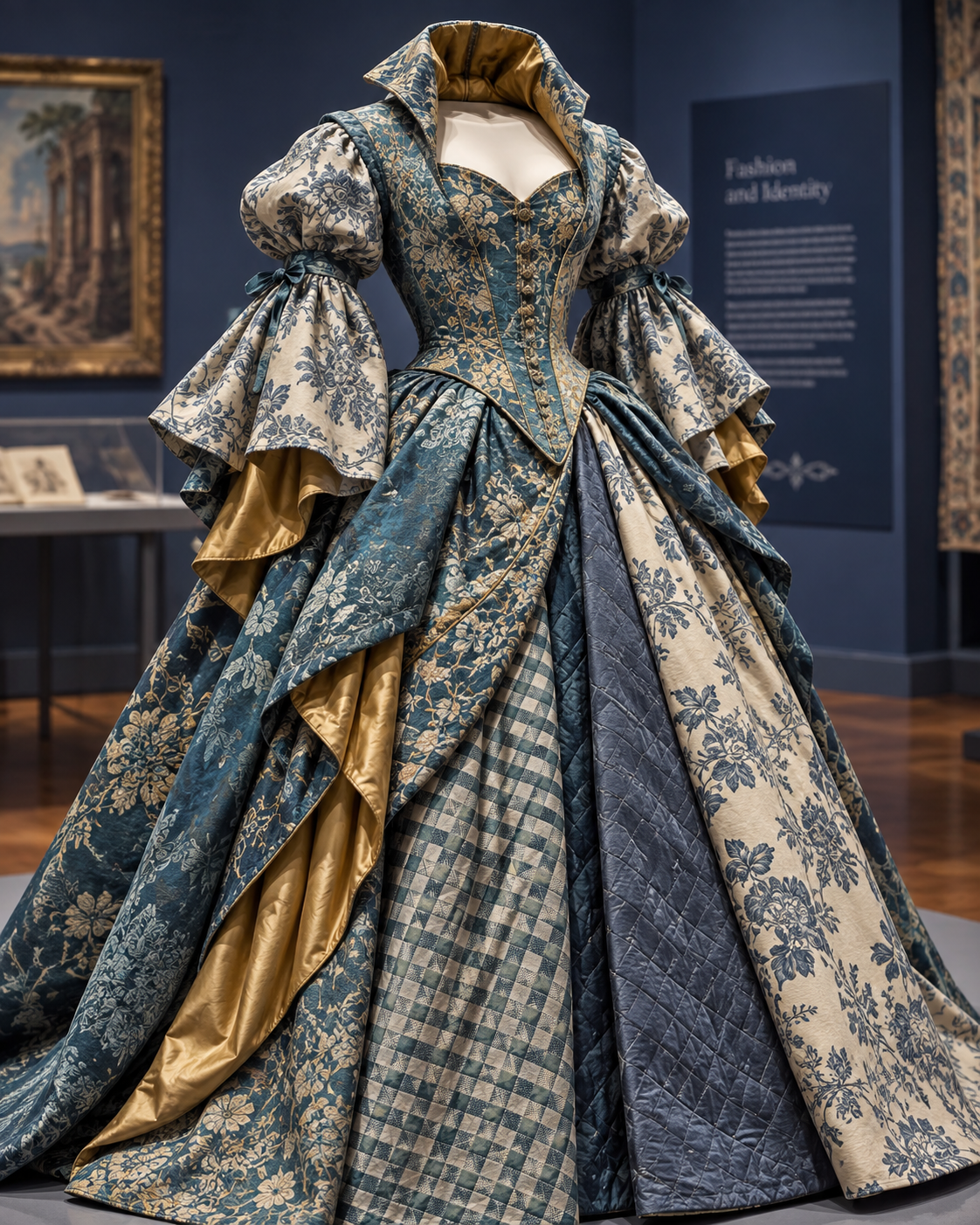
Christina Sharpe wrote about living in the unfinished aftermath of slavery. A residency at Manchester Art Gallery gives that theory a body, a silhouette and a name.
In In the Wake: On Blackness and Being (2016), the cultural theorist Christina Sharpe proposed "the wake" as a way of naming a condition rather than an event: the sense of living inside the unfinished aftermath of slavery, where the past keeps arriving in the present rather than settling safely behind it [1]. Sharpe's project was as much about method as content — she asked what it would mean to read history, art and everyday life while staying inside that condition, rather than treating grief as something a society works through and then leaves behind.
Holly Graham's residency at Manchester Art Gallery, which concluded earlier this month after nearly two years of archival research, takes Sharpe's method almost literally, cutting it into cloth. The centrepiece of Graham's project is a Victorian-silhouette costume, co-made with her mother, the costumier Jennifer Graham, from cloth woven at Quarry Bank Mill. Its shape is modelled on a dress worn by the American abolitionist Sarah Parker Remond, who addressed Manchester's Athenaeum on the true basis of the city's cotton wealth in 1859 [2]. Remond's specific charge that day — that the profits of empire never reached the hands that produced them — now sits at the centre of Graham's research into the subscriber ledgers of the Royal Manchester Institution, the gallery's own forerunner.
What makes Graham's costume a genuinely Sharpean object, rather than simply a well-researched piece of historical dress, is its refusal to treat 1859 as closed. The garment's construction performs this refusal materially: an outer layer of Manchester check gives way, through several worn layers, to an inner marbled print referencing the gallery's own institutional record books, so that undressing the piece re-enacts the movement from surface to buried archive that Sharpe's book asks its readers to make. The costume does not simply represent Remond; Graham extends her. In a performance titled Speaking Back, Graham wears the dress while leading visitors on a tour of the collection, naming the same donors and industrialists whose fortunes still quietly furnish the gallery's walls.
This talking-back structure draws on a second, related source: bell hooks' Talking Back (1989), which framed a previously silenced group's speech as a form of resistance in its own right, rather than a preliminary step towards some other, more legitimate response [3]. Where Sharpe supplies the durational logic — grief and its structures as ongoing rather than resolved — hooks supplies the specific gesture the exhibition performs: a Black woman speaking inside an institution partly built on the profits of labour by people who were never permitted to speak inside it. Graham has noted that her own position, addressing Manchester at close to the age Remond was in 1859, is not incidental to the work but part of its argument.
The exhibition's Sharpean logic is tested most directly in its handling of the gallery's own gaps. Graham chose to work with pattern books and archival material never formally accessioned into the collection — material that exists in a kind of institutional wake of its own, present on site but undocumented in the catalogue. Read through Sharpe's framework, this choice does more analytical work than a conventional wall label could, treating the gallery's own omissions as evidence, continuous with the shipping records that tied Manchester's largest cotton spinners directly to plantations on Edisto Island, South Carolina — a connection independently traced by researchers working alongside Graham through the Global Threads research partnership [4].
Sharpe's book resists offering any resolution, insisting that wake work has no clean terminus, only a continued attentiveness. Graham's residency closed on 6 September, but the costume has now entered Manchester Art Gallery's permanent collection, alongside a filmed record of Speaking Back. The piece therefore does not conclude so much as change tense: from an event visitors could attend, to an object the institution must now continue to hold, and be held by.
Bibliography
[1] Sharpe, C. (2016). In the Wake: On Blackness and Being. Durham, NC: Duke University Press.
[2] Remond, S. P. (1859). Speech at the Manchester Athenaeum, as researched for The Warp/ The Weft/ The Wake, Global Threads, 2026. globalthreadsmcr.org/the-warp-the-weft-the-wake
[3] hooks, b. (1989). Talking Back: Thinking Feminist, Thinking Black. Boston, MA: South End Press.
[4] Global Threads (UCL Centre for the Study of the Legacies of British Slavery, with the Science and Industry Museum). Research on Manchester's cotton trade and Quarry Bank Mill, 2026. globalthreadsmcr.org/the-warp-the-weft-the-wake