
THE BEARER OF THE LOOK
By Lisa Knoll
02/10/2026
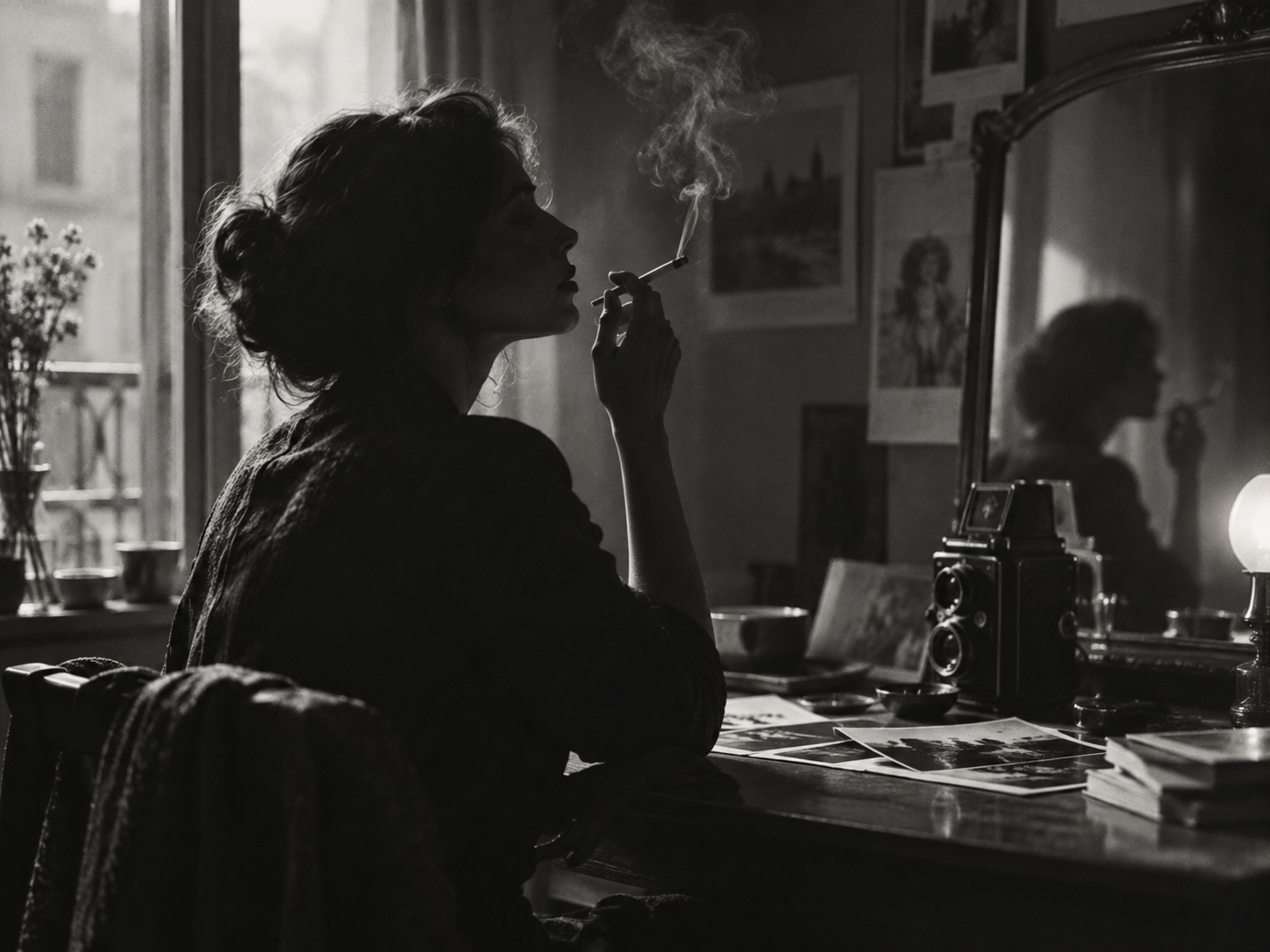
According to Laura Mulvey, the camera's gaze is coded male — women are positioned to be looked at, not to look. Lee Miller's own nude photography, seen in full at Tate Britain, asks what changes when a woman finally holds the camera, and what stubbornly doesn't.
In her 1975 essay "Visual Pleasure and Narrative Cinema", Laura Mulvey argued that the camera's eye is not a neutral instrument but a coded one: cinema, and by extension much of visual culture, positions the woman as spectacle and the man as the "bearer of the look", the active party for whom images of women are constructed to be seen. A woman photographed, in Mulvey's account, exists to satisfy someone else's gaze rather than to organise the frame herself [1]. Tate Britain's Lee Miller retrospective opens, almost provocatively, with exactly this arrangement — and then spends the rest of its rooms complicating it.
The exhibition's first gallery presents Miller as she began: photographed nude, in soft, hazy studies of her own torso, by Edward Steichen and others who first made her a face and a body for the camera in 1920s New York. It is a deliberate curatorial choice to start there, in the position Mulvey's framework would predict for her — subject, not author, of the look. What the show then traces, deliberately and at length, is Miller's move to the other side of the lens: her apprenticeship with Man Ray in Paris, her own experiments with solarisation, and eventually her own nude photographs of other women, made using techniques and compositions strikingly close to those Man Ray and Steichen had once used on her [2].
This is where Mulvey's framework earns its keep as a genuine test rather than a label. If the "male gaze" is simply a property of who is standing behind the camera, Miller's nudes of other women should read as a straightforward correction — a woman finally wielding the active look Mulvey associated with masculinity. But several of Miller's solarised torsos and fragmented nude studies from this period reproduce almost exactly the same visual grammar she had modelled for: the body cropped at the neck and knee, lit to emphasise curve over identity, presented as form rather than person. The apparatus of "to-be-looked-at-ness", to use Mulvey's phrase, does not simply dissolve because a woman is now operating the shutter.
This does not mean nothing changed when Miller crossed from one side of the camera to the other. Having been positioned as spectacle herself, she photographed other women's bodies with a specificity — an attentiveness to how solarisation could dissolve a torso into something closer to landscape or sculpture than flesh — that reads less like appetite and more like formal curiosity carried over from her own experience of being looked at. The Tate's decision to hang her early nude portraits and her later nude photography in dialogue, rather than treating the first as biography and the second as art, makes this continuity impossible to miss.
Read through Mulvey, then, Miller's career offers something more interesting than a simple reversal of the gaze. It suggests that the visual conventions Mulvey identified are sturdier than their supposed authorship: a woman behind the camera does not automatically produce a "female gaze" free of the grammar she grew up inside, and Miller herself did not pretend otherwise. What she does complicate is the fixed correspondence Mulvey's essay implies between position and power — bearer of the look, object of the look — by having occupied, documented and eventually photographed from both positions within a single career. The exhibition's real subject may not be Miller's nudes at all, but the far stranger fact of a woman who spent decades on both sides of the same lens, and left a body of work that refuses to say which side finally won.
Bibliography
[1] Mulvey, L. (1975). "Visual Pleasure and Narrative Cinema." Screen, 16(3), pp. 6–18.
[2] Chadwick, W. (1985). Women Artists and the Surrealist Movement. London: Thames & Hudson.