
ACCORDING TO BERGER
By Lisa Knoll
17/09/2026
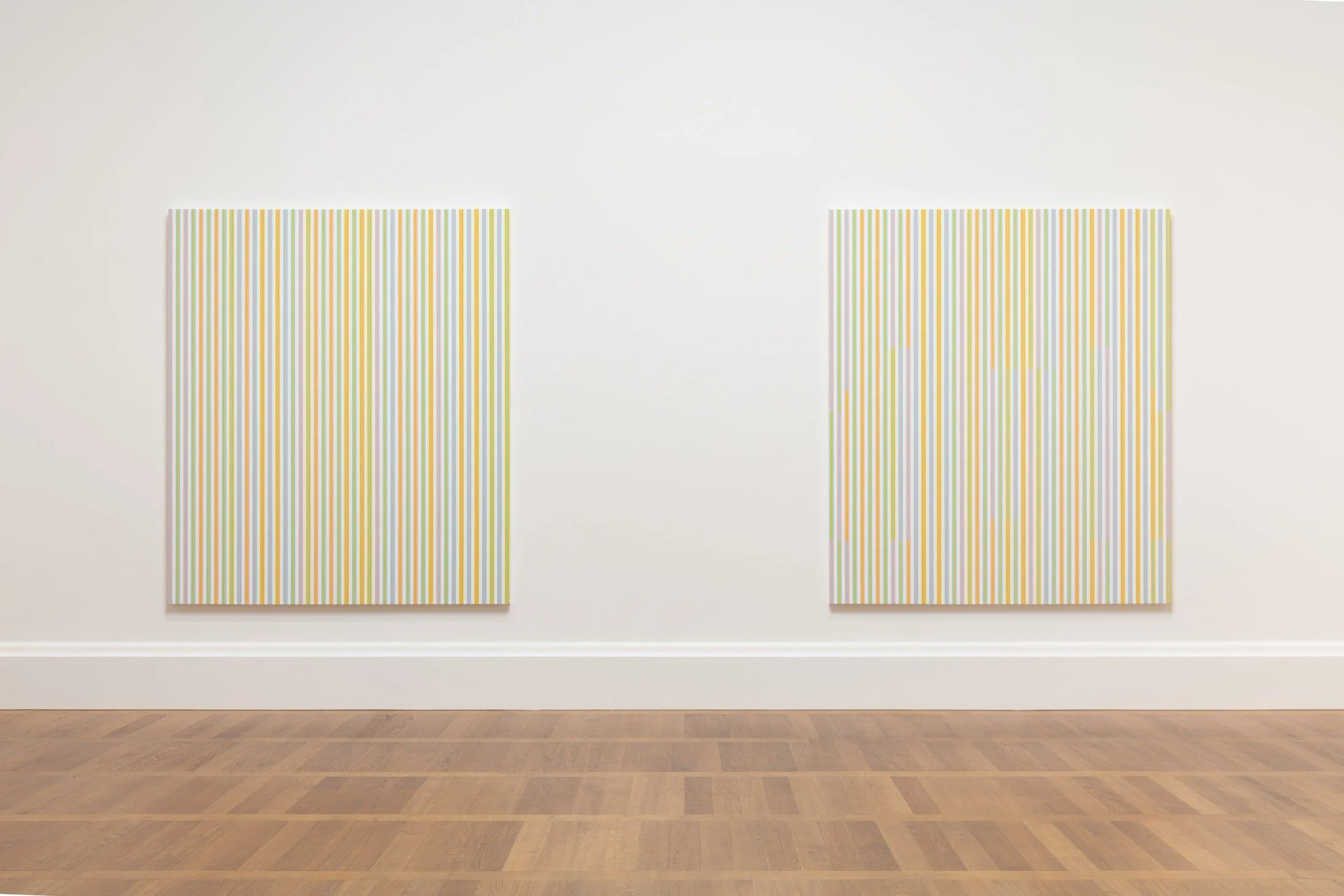
Fifty years after “Ways of Seeing”, a new Bridget Riley gift to Tate Britain asks the same question again
Bridget Riley, Concerto I, 2024. Tate, presented by the artist 2025.
John Berger opened Ways of Seeing with a claim precise enough to still cause an argument fifty years on: “The way we see things is affected by what we know or what we believe” [1]. Berger’s target was not perception in the physiological sense but the ideology embedded in how a culture teaches its members to look — an argument he built specifically against the assumption, then dominant in art-historical writing, that a painting’s meaning sits fixed within the canvas, waiting to be correctly decoded by a sufficiently trained eye.
Bridget Riley’s recent gift to Tate Britain — Concerto I (2024), now on display alongside her 1963 painting Fall — offers an unusually direct test of Berger’s argument, because Riley’s own practice has spent six decades explicitly refusing the premise that meaning sits still in a painting waiting to be found. Her optical abstractions are built, deliberately, to change under the viewer’s own eye movement: what appears as a fixed arrangement of line and colour from one angle destabilises into apparent motion from another, so that the work’s meaning is never quite separable from the specific act of looking that produces it.
This is not merely a formal trick. Riley herself has described her practice as concerned with “the sensory experience of sight” rather than with fixed pictorial content — a phrasing that sits remarkably close to Berger’s own insistence that seeing is an active, culturally shaped process rather than a passive reception of visual information already complete before the eye arrives. Where Berger made his case largely through the history of oil painting and its relationship to property and possession, Riley’s abstractions make a related case through pure perceptual mechanics: there is, quite literally, no single “correct” way to see a Riley painting, because the painting is engineered to resist settling into one.
The pairing of Concerto I with Fall, recently conserved using plant-based cleaning techniques to lift decades of accumulated grime from its delicate surface, adds a further, more literal dimension to Berger’s argument. A newly cleaned sixty-year-old painting is not simply restored to some original, fixed state of visibility; conservation itself is an interpretive act, a decision about which layer of the work’s material history counts as its “true” appearance for a contemporary viewer. Berger would probably have relished the irony: even the supposedly neutral, technical process of conservation cannot escape the culturally situated question of how a work ought to be seen.
What makes this pairing worth attention beyond the anniversary coincidence is what it suggests about the durability of Berger’s central claim. Fifty years of subsequent art history — much of it explicitly building on or arguing against Berger’s framework — have not settled the question of whether seeing can ever be separated from the beliefs a viewer brings to it. Riley’s paintings, on continuous public display at Tate Britain through June 2026, function as a kind of standing experiment on exactly that question: stand in front of Concerto I for long enough, and Berger’s fifty-year-old provocation stops being a historical argument and becomes something closer to a demonstrable fact about your own eyes.
[1] Berger, J. (1972). Ways of Seeing. London: Penguin Books, p. 8.