
WHAT CONSERVATION FOUND UNDER MONET'S VARNISH
by Darriel Patrick
01/10/2026
Exhibition
Monet: Painting Time
Curator: Juliet Bingham (with Genevieve Barton, assistant curator)
Dates: 25 February – 27 June 2027
Venue: Tate Modern, London
Tate Modern has never devoted a full exhibition to Claude Monet. Given the gallery's twenty-five years and Monet's status as perhaps the single most reproduced painter in Western art, that omission is worth pausing on before the show itself opens — and the reason it is finally closing offers a useful way into what Monet: Painting Time is actually trying to do.
The occasion is partly conservation news. Tate's own restorers have spent recent months removing decades of yellowed, non-original varnish from the gallery's The Seine at Port-Villez (1894), and the results have changed how the painting is being read. Speaking at a press briefing on 16 September, Genevieve Barton, assistant curator of international art at Tate Modern, said the cleaning had uncovered "the artist's sense of luminosity, which has not been seen in decades." That single conservation project has effectively become the exhibition's founding argument: that Monet's paintings are not fixed objects but records of light changing in real time, and that seeing them properly sometimes means removing what later hands have added.
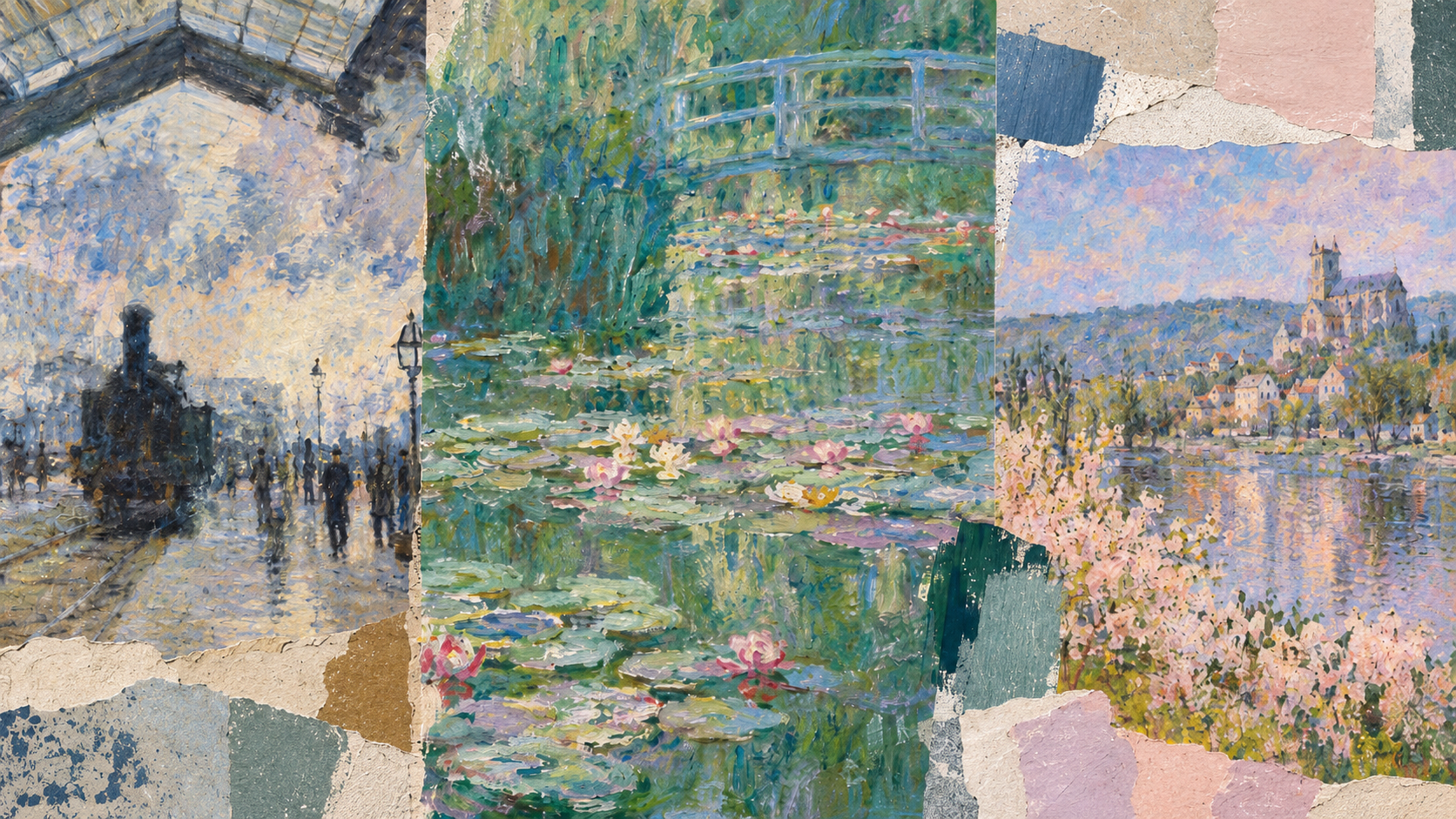
The show, running 25 February to 27 June 2027, builds outward from that premise across three thematic sections. The first traces Monet's fascination with industrial modernity, anchored by his 1877 studies of the Gare Saint-Lazare, including a loan of Arrival of the Normandy Train, Gare Saint-Lazare from the Art Institute of Chicago. The second and third sections turn to his serial method — the grain stacks, Rouen Cathedral, and roughly twenty water lily paintings drawn from institutions including Tokyo's Artizon Museum and the Musée Marmottan Monet in Paris — tracking how repetition became, for Monet, a way of making duration itself visible on canvas.
One loan is particularly notable for what it says about UK institutional collaboration rather than Monet himself: the National Gallery has agreed to lend The Water-Lily Pond (1899), a decision curator Juliet Bingham frames as evidence of closer working ties between the two London institutions, following the National Gallery's own recent move into collecting twentieth- and twenty-first-century work. A further room will address Monet's continuing pull on contemporary practice, screening the French artist Ange Leccia's video work (D)'Après Monet (2020).
The exhibition is sponsored by Morgan Stanley alongside Anthropic, the AI company that has backed several recent Tate presentations, including Electric Dreams: Art and Technology Before the Internet and the ongoing Julio Le Parc: Light. Colour. Action. Tate has confirmed there are no plans to repeat the interactive Claude-and-Monet programming staged at San Francisco's de Young Museum earlier this year, when Anthropic sponsored a comparable Monet exhibition there.
Whether Painting Time changes how visitors see an artist this familiar is, inevitably, an open question the show can only answer once it opens. But the conservation work behind The Seine at Port-Villez already makes a quieter point worth noting now: sometimes the most significant new research on a two-hundred-year-old painting is not a new archival discovery, but the simple, careful removal of what should never have been there.
Exhibition Facts:
Exhibition: Monet: Painting Time
Curator: Juliet Bingham (with Genevieve Barton, assistant curator)
Dates: 25 February – 27 June 2027
Venue: Tate Modern, London