
CARC x Strange Field:The Suspense of Opening Grandma’s Mystery Casserole
by Darriel Patrick
18/8/2026
Location
105-109 French Street
Glasgow
G40 4EH
Absurdity, humour and the art of inhabiting fear at Strange Field in Glasgow’s East End
CARC (Centre for Arts, Research and Culture) is pleased to present, in collaboration with Strange Field (Instagram), The Suspense of Opening Grandma’s Mystery Casserole, a group exhibition curated by Alexandra Orlova (Instagram) and presented at Strange Field in Glasgow. Bringing together eleven artists working across film, photography, sculpture, installation and augmented reality, the exhibition opens the first chapter of Orlova’s trilogy devoted to the art of laughing at fears. Hosted in Strange Field’s warehouse space at 105–109 French Street in Glasgow’s East End, the show ran from 10 to 13 August 2026. Strange Field confirms 105–109 French Street, Glasgow G40 4EH as its address.
Conceived as Chapter I: absurdity and humour, the exhibition traces how everyday anxieties, irrational suspicions and domestic superstitions can shift once we begin to look at them askew. Orlova’s curatorial text introduces the figure of the child who finally lifts the lid of Grandma’s forbidden casserole: a moment in which dread, curiosity and pleasure collide. Rather than treating fear as something to eradicate, The Suspense of Opening Grandma’s Mystery Casserole focuses on the interval around it – the pause before something happens, the delay between recognition and acceptance, and the comic excess that appears when our reactions no longer match the scale of the situation.
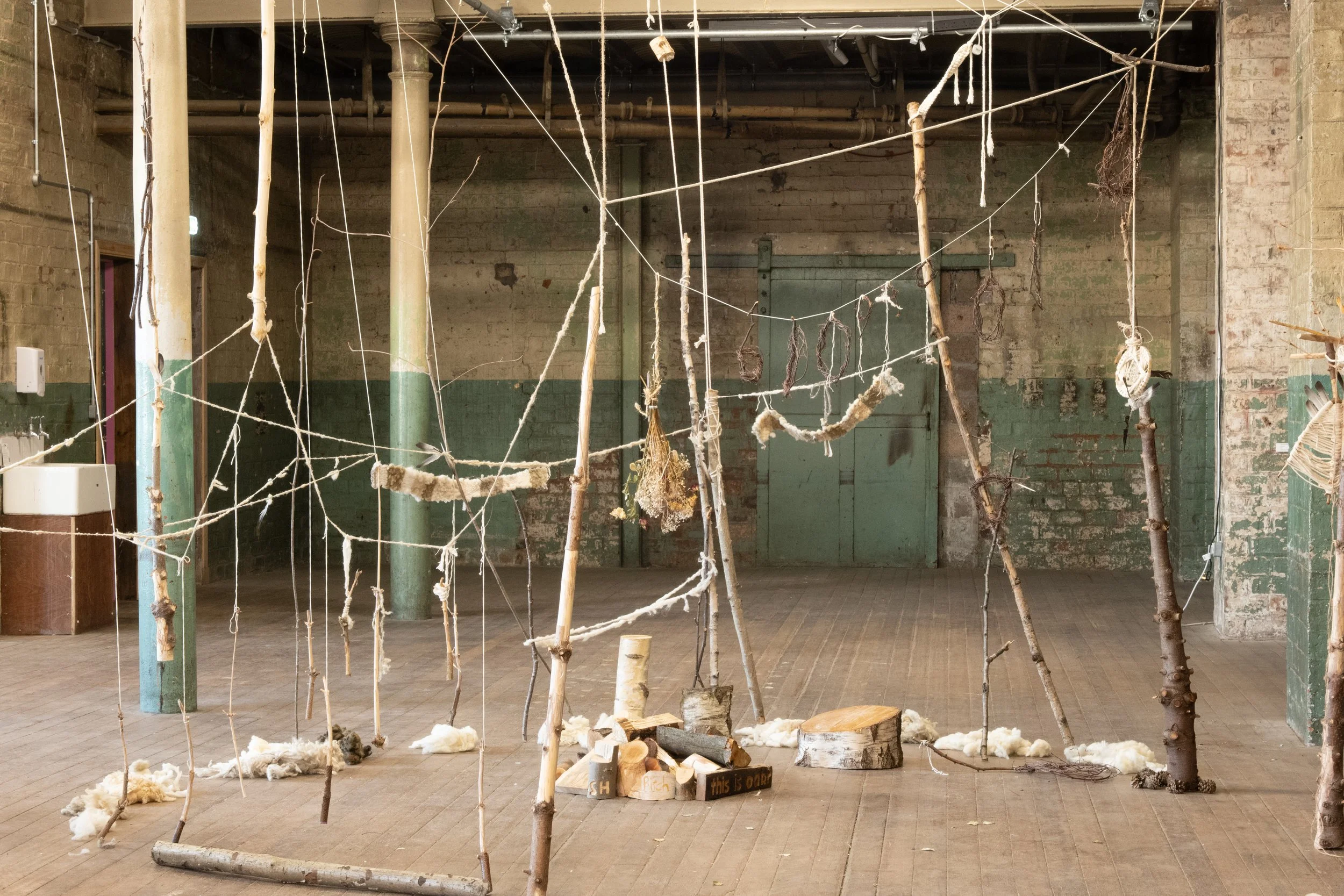
At the centre of the exhibition stands Tree Museum (2026) by Luke “Luca” Cockayne (Instagram @luckycockayne), an installation that gathers together branches, pieces of wood, feathers, yarn, badly spun wool and dried flowers into a precarious circular structure. Cockayne’s website and Glasgow Sculpture Studios identify him as a Glasgow-based conceptual artist and writer.
Working through an almost compulsive process of collecting ordinary natural and handmade materials, Cockayne transforms what initially looks like accumulated debris into an environment granted the status of a “museum”. The work plays with institutional language and expectations: a wobbly rope-and-wood construction becomes an unlikely site of cultural value, inviting visitors into a space that is at once fragile, absurd and reminiscent of improvised forest shelters from childhood.
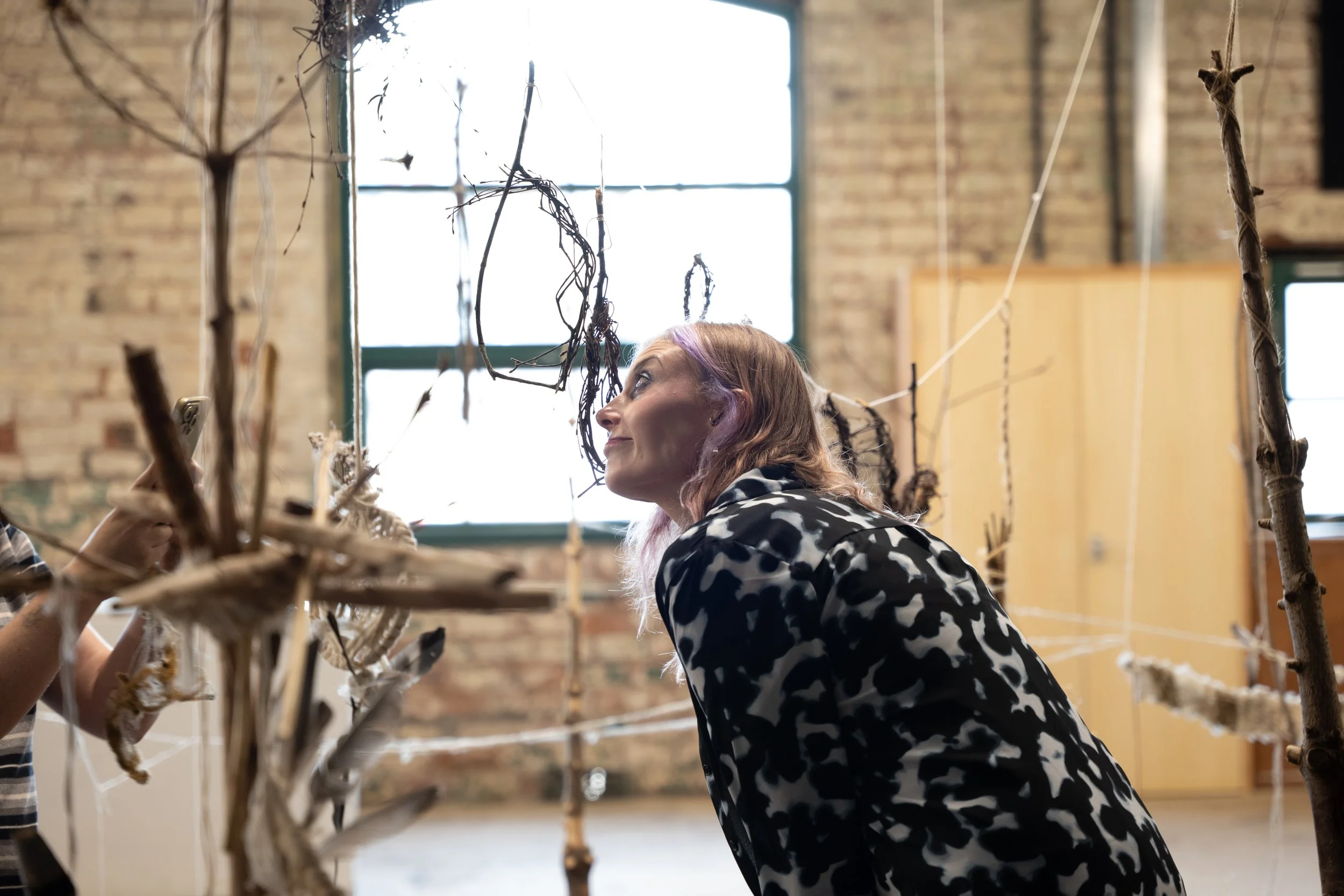
Visitor with Luke ‘Luca’ Cockayne, Tree Museum, 2026, branches, wood, yarn, feathers and wool. Installation view, The Suspense of Opening Grandma’s Mystery Casserole — Chapter I: Absurdity and Humour, Strange Field, Glasgow, 10–13 August 2026. Courtesy of the artist and Strange Field. Photo: Choin Lee.
Several artists approach fear and suspense through intimate storytelling and the domestic sphere. Imogen Cowan(Instagram @immmoogen)’s film Questo Ti Volevo Dire (2025) unfolds as a triptych across three generations of women, following Elena’s attempt to leave the family home while her grandmother Wanda delays the departure through folklore, superstition and narrative detours. The supplied Instagram account is identifiable as Imogen Cowan’s profile.
Drawing on the visual atmosphere of 1980s Italian cinema, Cowan turns an ordinary household encounter into a reflection on memory, womanhood and family mythology, where absurd rituals become a way of containing the anxiety of change.
A different but related strategy appears in Kate Glenn (Instagram @kateglennartist)’s video Story Time, Hold for 2x(2026), shown on an iPhone. Glenn’s official site identifies her interdisciplinary practice and links to her Instagram; Glasgow School of Art also profiles her MFA practice.
Adopting the language of TikTok-style personal monologue, Glenn recounts a traumatic healthcare experience linked to endometriosis and the insertion of an IUD, appearing in her bedroom in lingerie printed with images from her surgery. Here humour is not decorative; it is a means of reframing bodily trauma, turning “tragedy plus time” into a narrative that can be shared, questioned and, cautiously, laughed at.
Other works probe the moment when minor bodily or domestic disturbances tip over into disproportionate psychological weight. In Body for the Inside (2026) and Delayed Moles (2025), Yujin Lee (Instagram @t_inn_) begins from small incidents: broken household objects that lose their function, or the uncertainty of whether a mole has always been present on the skin or appeared recently. The supplied @t_inn_ account is publicly associated with Yujin’s Glasgow art practice.
In Lee’s practice, fabric drawn over in pencil suggests a kind of skin, under which a fragile skeletal structure emerges; the body seems to react before the mind fully understands what is happening. These works dwell in the delay between noticing that something is wrong and accepting it, showing how mundane ambiguity can expand into uncanny anxiety.
A related shift from the familiar to the unsettling appears in Maxima Smith (Instagram @maximasmith)’s looping video Ha ha ha (2016), where a machine produces a repeated approximation of human laughter. Smith’s official website describes her London-based practice as primarily focused on film, gesture, movement and mimicry.
Stripped of human presence, laughter – normally associated with pleasure and sociability – gradually becomes mechanical and eerie, moving the work into the space between comedy and threat.
The exhibition also foregrounds how local folklore, memory and superstition shape our relationship to fear. In her works Backcourt Liz (2026), Stymie Steamie (DO NOT HOG THE WASHING LINE.) (2024), BE HAPPY (2026) and A Cast of Characters (2025), Elizabeth Riddell (Instagram @riddell_atelier) works with Glasgow tenement backcourts, commemorative objects, coded instructions and collective signatures.
An eccentric woman in a backcourt becomes an unlikely heroine reproduced on a plate; a dispute over the washing line turns into an absurd, colour-coded monument; a brightly painted phallic sculpture carries the injunction “BE HAPPY”, born from a linguistic misunderstanding; a plaster cast gathers the marks of writers, musicians and artists alongside traditional symbols to form a talisman that is both sincere and knowingly ridiculous.
Through these pieces, Riddell examines who is remembered and celebrated, how humour interacts with quiet menace, and why we attach protective power to objects even when we are aware of their limits.
Photography and painting contribute further perspectives on suspension and anticipation. Daniil Nevskiy (Instagram @dnevskij)’s small black-and-white analogue photographs – such as Stillness (2025) and Preparation (2024) – capture figures poised between states, whether inhabiting urban space or caught in domestic intimacy. The public @dnevskijaccount identifies Daniil Nevskij as a London-based cinematographer.
Their precise compositions and held moments invite viewers to imagine what might follow after the shutter closes, creating psychological spaces in which personal stories can unfold.
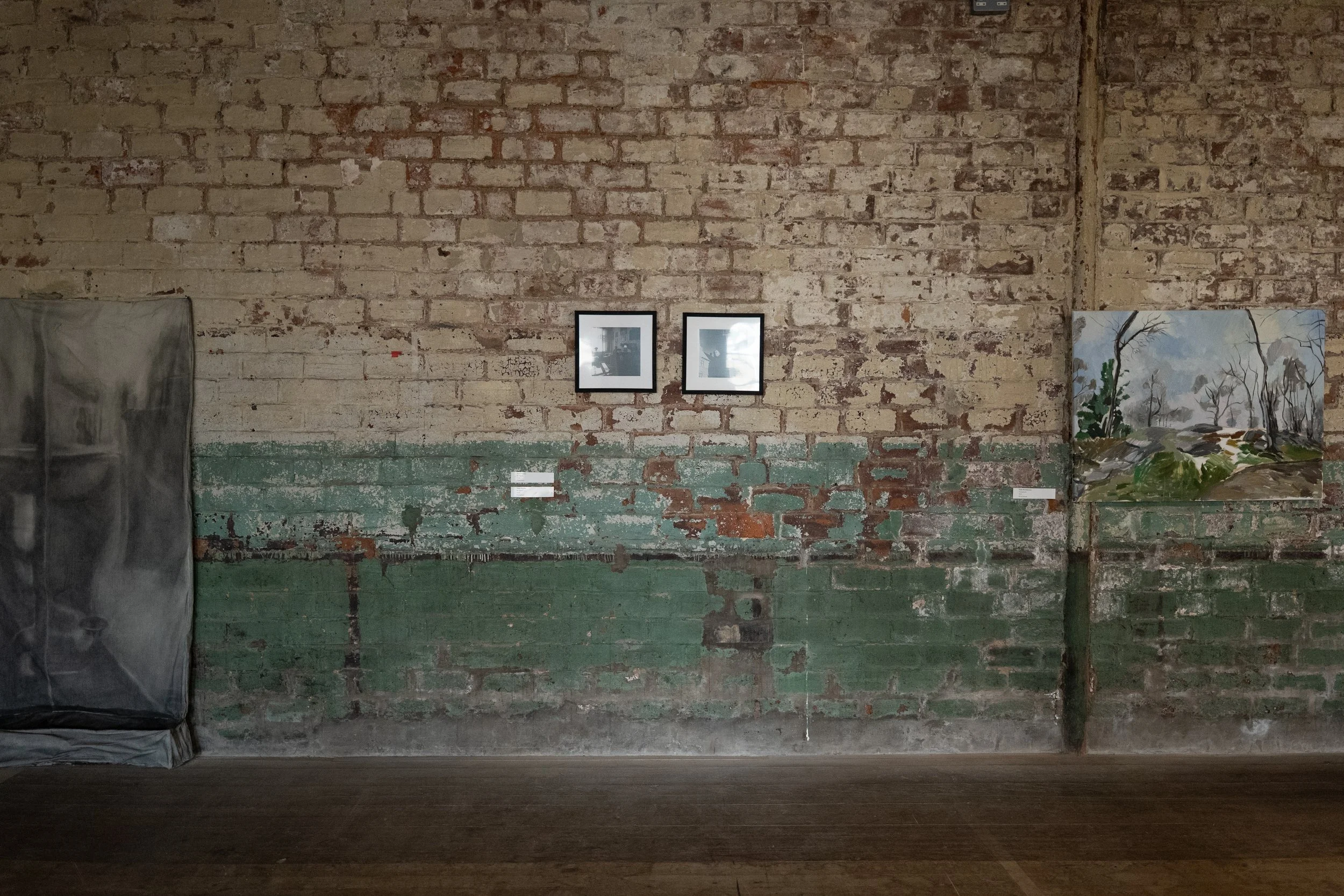
Installation view of The Suspense of Opening Grandma’s Mystery Casserole — Chapter I: Absurdity and Humour, featuring Daniil Nevskiy, Stillness, 2025, and Preparation, 2024, photographs; and Vlada Markidanova, Transperant, 2025, oil on canvas. Strange Field, Glasgow, 10–13 August 2026. Courtesy of the artists and Strange Field. Photo: Choin Lee.
Vlada Markidanova’s practice, spanning painting, drawing and sculpture, similarly engages viewers as co-authors of perception: in works such as Transperant, fragments and blurred landscapes act as generic images that only become legible once visitors project their own memories into them. The supplied artist name is also corroborated in Strange Field-related exhibition material.
Margarita Shuvaeva, working across painting and raku ceramics, extends the unpredictability of the firing process into her approach to paint, treating the medium not as a passive carrier of intention but as an active agent whose behaviour can exceed the artist’s control. Her painting and raku practice has also been independently discussed by Two Coats of Paint.
In works such as St Peter, diluted paint slips away from fixed gesture, allowing observation to be the beginning rather than the end of the process.
Taken together, the artists in The Suspense of Opening Grandma’s Mystery Casserole do not propose simple cures for fear. Instead, they invite us to inhabit the space around it: to pause with uncertainty, to notice how memory and superstition attach themselves to objects, and to see how humour can loosen the grip of the unknown without denying its presence.
By presenting this first chapter of Orlova’s trilogy in collaboration with Strange Field, CARC highlights contemporary practices in which absurdity and laughter are not distractions from anxiety, but ways of reshaping it – much like the moment of raising the casserole lid and discovering, beyond the initial apprehension, the familiar warmth of something shared.
Exhibition:The Suspense of Opening Grandma’s Mystery Casserole — Chapter I: Absurdity and Humour
Curator: Alexandra Orlova
Dates: 10–13 August 2026
Venue:Strange Field (Instagram), 105–109 French Street, Glasgow G40 4EH
Presented by:CARC — Centre for Arts, Research and Culture in collaboration with Strange Field