
An Interview on Unbordered Selves
By Lisa Knoll
1/3/2023
Exhibition Details:
Art Gallery 13, Bishop’s Stortford | 18 – 28 February 2023
Rituals for an Unbordered Self (5 Ducketts Wharf, South Street, Bishop’s Stortford, CM23 3AR)
Image © Art Gallery 13
Following the 2023 exhibition Rituals for an Unbordered Self at Art Gallery 13 (18 – 28 February 2023), this interview traces the conceptual, biographical, and political foundations of Varvara Dmitrieva’s photographic practice. Centred on large-scale analogue prints produced during her residency at Photofusion in London, the exhibition explored identity as something provisional, porous, and resistant to the imperial narratives that shape contemporary subjectivity. Speaking with critic Lisa Knoll, Dmitrieva reflects on her formation between Russia, Italy and the UK, the feminist and decolonial ideas underpinning her work, and her unequivocal stance against Russia’s war in Ukraine.
Lisa Knoll:
Your work often seems to emerge from biography—not as personal confession, but as something atmospheric, a texture of thinking. After Rituals for an Unbordered Self, how do you see your own history inhabiting the work?
Varvara Dmitrieva:
It appears in the work the way a scent or a temperature permeates a room. Growing up in Moscow—between Soviet remnants and hastily manufactured modernity—made me aware very early that identity is unstable. The city didn’t speak with one voice; it spoke in contradiction. Nothing aligned. So I became attuned to fracture, ambiguity, the tension of stories that don’t quite fit.
As a child I instinctively drew faceless figures, without knowing why. Much later I understood that I was already recognising how fragile the self feels when placed inside narratives you didn’t choose. That atmosphere has never left my work.
LK:
Your biography mentions discovering feminist and decolonial writing in your teens. Did that give structure to these early, intuitive impulses?
VD:
Yes, it transformed intuition into understanding. Feminist and decolonial thinkers taught me that the dissonance I felt wasn’t a personal failing—it was produced by systems that regulate identity, gender, history. They helped me see the mask not as concealment but as a strategy of defiance, a way of stepping back from identities imposed upon you.
When I later began moving between Italy and the UK, that defiance became a lived experience. Shifting languages, landscapes, gestures—it created a sense of drifting between cultural currents rather than belonging to any of them. My work began to grow from that drift.
LK:
Your analogue prints have become a signature of your practice. How did your time at Photofusion influence this?
VD:
Photofusion shaped me profoundly. It was the first place where analogue photography felt alive rather than nostalgic. I learnt there that the darkroom is not merely a technical workspace but a philosophical environment. You cannot rush an image into being; you have to negotiate with it.
Working alongside printers and artists who valued slowness taught me to treat analogue as resistance: resistance to acceleration, to dematerialisation, to visual extractivism. My participation in Salon/21 pushed that further—it helped me understand that analogue printing can function as an ethics of attention.
In Rituals for an Unbordered Self, the scale of the prints, and the tactility of grain, are inseparable from the work’s conceptual intentions. They offer a rhythm the digital cannot accommodate.
LK:
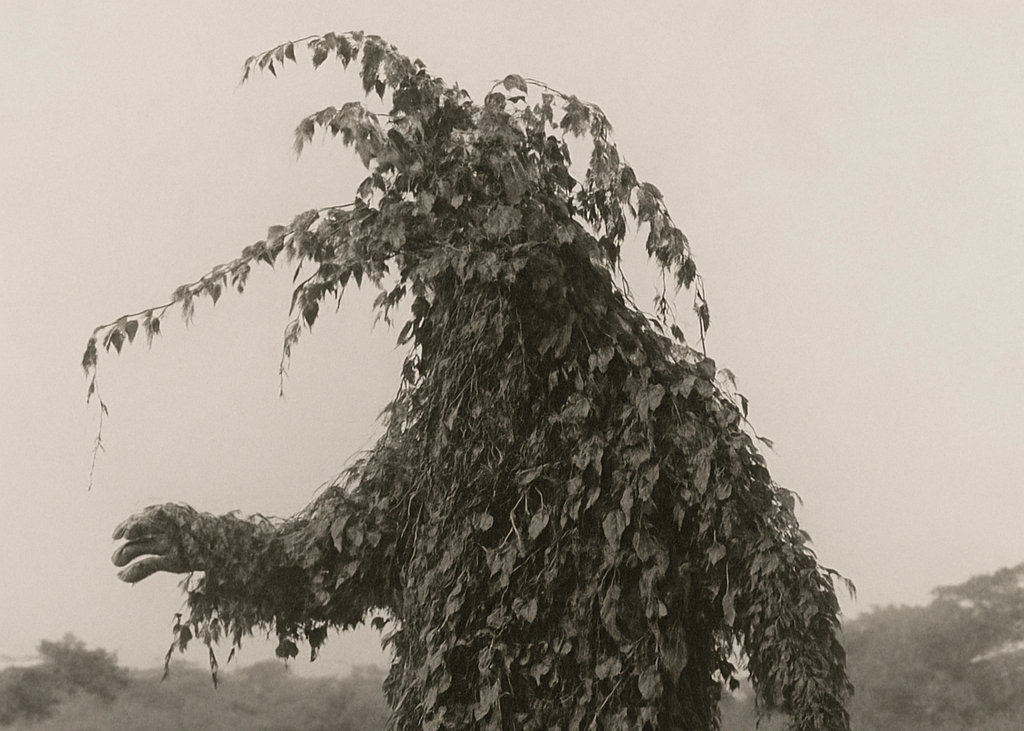
The figure in this exhibition feels unmoored—neither human in the conventional sense, nor symbolic in the folkloric sense. How did this being come into form?
VD:
I wanted a figure that could not be claimed. Something that rejected assumptions of nation, lineage, ethnicity. Leaves came naturally—they’re transient, itinerant, communal. They carry no ancestry.
I imagined a being made from accumulation rather than inheritance: a body composed of what attaches to it, rather than what defines it in advance. Identity as sediment, as drift. Something that could never serve state narratives or ideological scripts.
LK:
Your work has been described as anti-imperial and implicitly anti-war. How consciously do you position yourself in relation to Russia’s invasion of Ukraine?
VD:
Very consciously. I am unequivocally against the war in Ukraine—against Russian imperial violence, and against the destruction of lives, memory and land.
My practice has always been about refusing the myths that sustain empire: the toxic nostalgia, the fetish of unity, the fantasy of historical purity. When the invasion occurred, these themes became tragically real.
I will never aestheticise war, but my work stands firmly against the psychological infrastructures that make war imaginable. The leaf-covered figure is a position: a refusal to belong to imperial identity.
LK:
There is something ritualistic in your work, but without the structure of traditional ritual. How do you understand ritual in your practice?
VD:
Ritual is a way of attending to what cannot be spoken. It is a space of suspension, of hesitation. I’m interested in rituals that aren’t inherited but invented by necessity—rituals for people in transit, for fractured selves, for those who do not know where they belong.
The curator, Aleksandra, expressed it beautifully:
“These works do not illustrate ritual; they generate the conditions in which ritual becomes thinkable again.”
That perfectly describes what I am trying to do.
LK:
The viewer is forced to slow down in front of your images—there’s no instant comprehension. Is that intentional?
VD:
It is essential. The post-digital condition erodes our ability to look with patience or care. We skim, we scroll, we extract. My analogue worlds resist that. They require time because they are made of time.
The image doesn’t give you what you expect. You must stay, adjust, dwell. That act of dwelling becomes political—it is a refusal to participate in the speed that exhausts us.
LK:
Finally, what does “an unbordered self” mean to you now?
VD:
It means a self unclaimed by the narratives that harm it. A self not speaking the language of empire, not performing identity as obedience. A self that is porous, drifting, attentive—strong in its fragility.
An unbordered self is one that can refuse—and knows that refusal is a form of care.